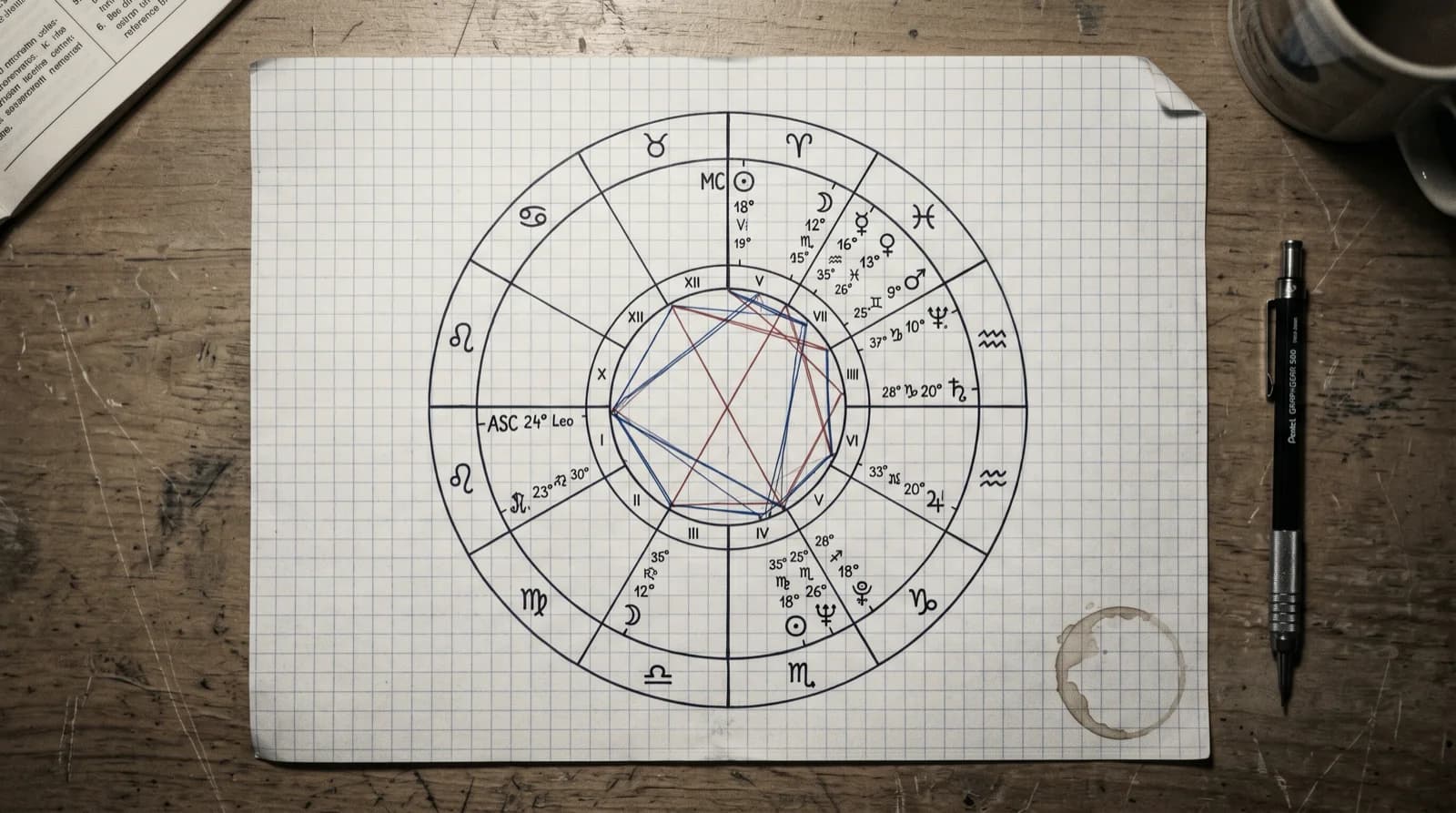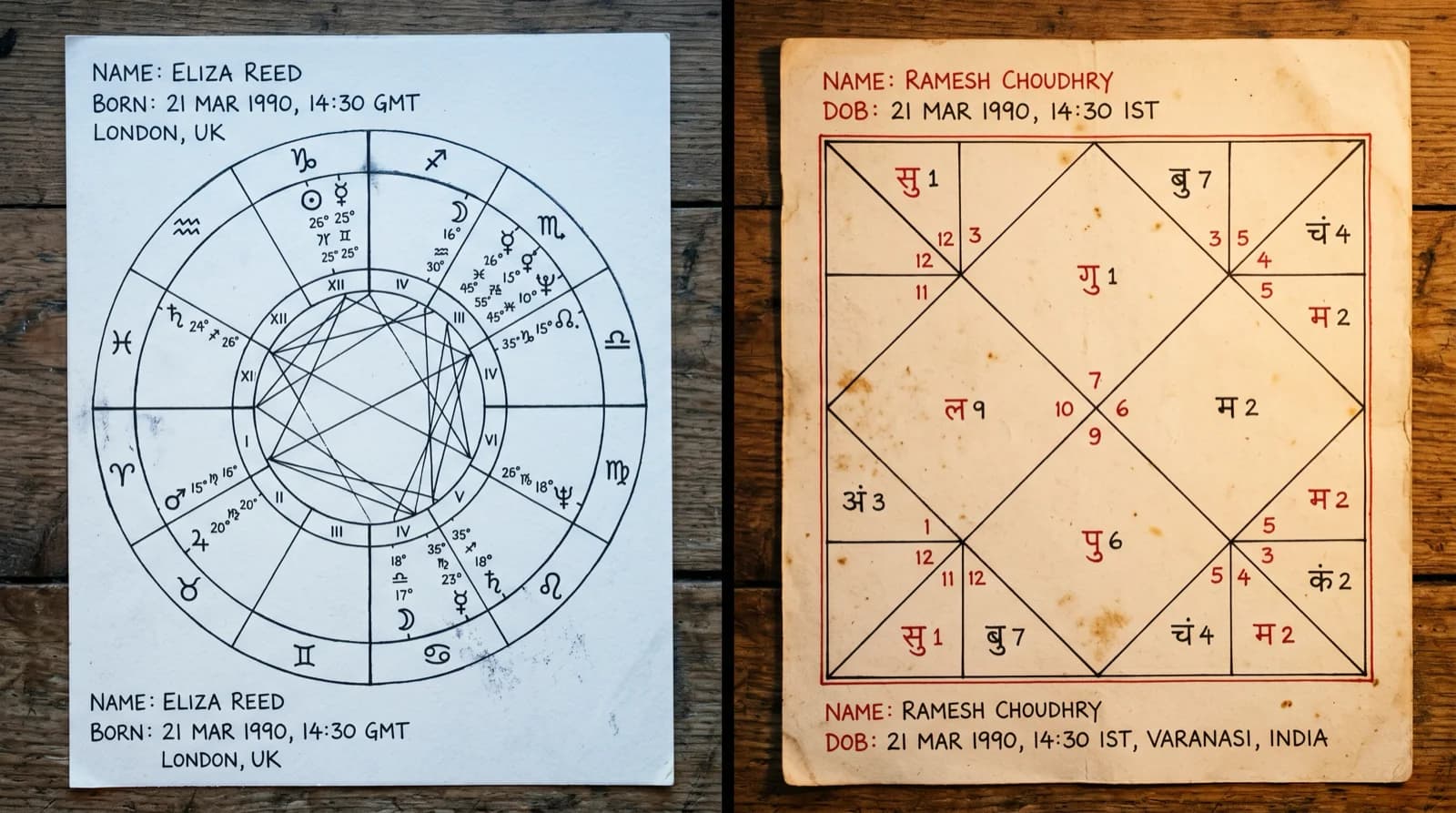
If you've explored both Western and Vedic astrology, you may have noticed something surprising: your Sun sign is often different between the two systems. You might be a confident Leo in Western astrology but a nurturing Cancer in Vedic. This isn't an error — it reflects fundamental differences in how these two ancient traditions measure and interpret the cosmos.
The Zodiac: Tropical vs Sidereal
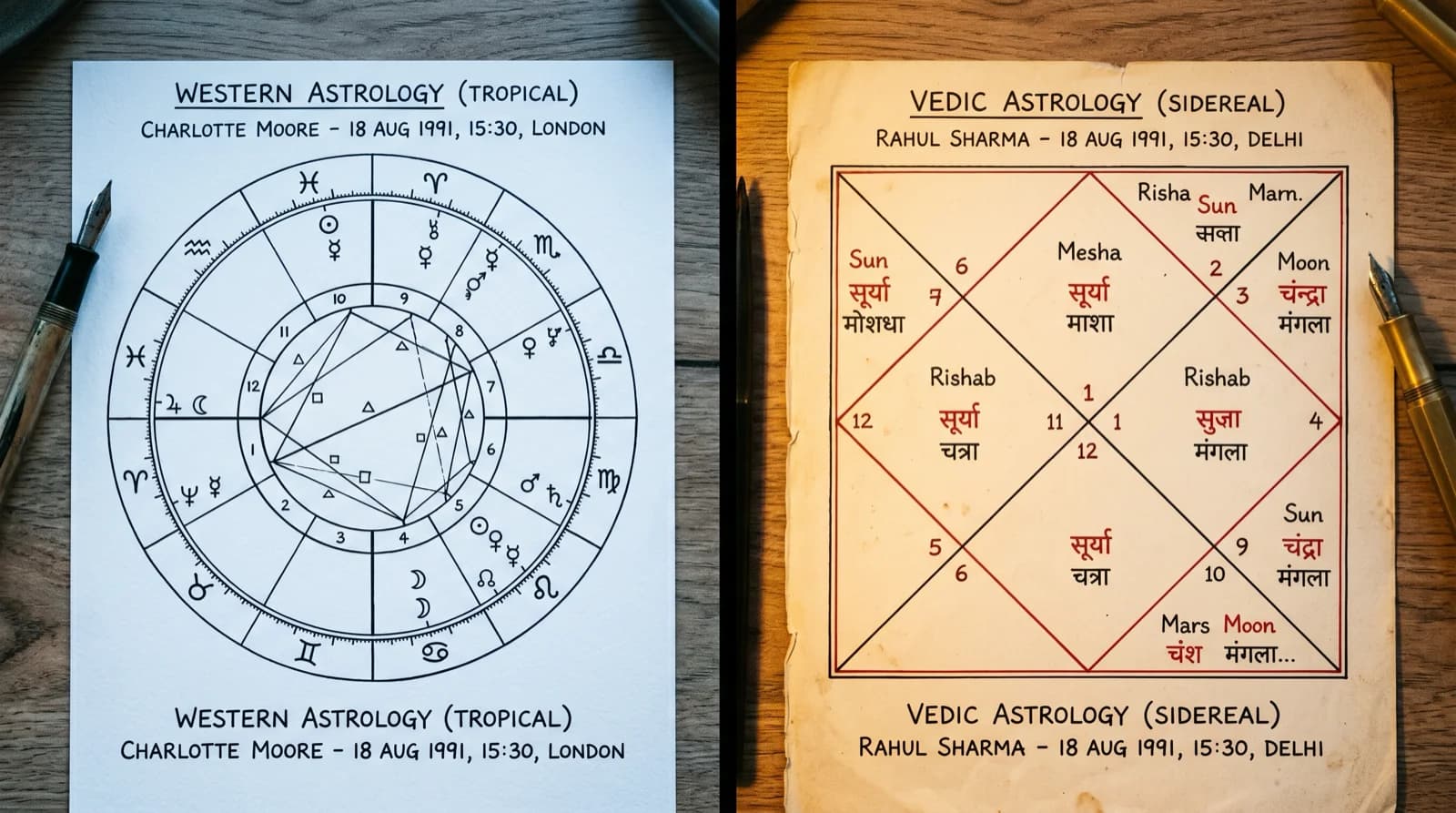
The most significant technical difference between Western and Vedic astrology is the zodiac system used.
Western Astrology: Tropical Zodiac
Western astrology uses the tropical zodiac, which is based on the relationship between Earth and the Sun, specifically the changing seasons. Aries begins precisely at the Spring Equinox (around March 21), when day and night are equal and the natural world begins its renewal.
The tropical zodiac is symbolic and seasonal, tied to the annual solar cycle rather than actual star positions. When the Sun enters 0° Aries, it marks the beginning of spring in the Northern Hemisphere, regardless of what constellation appears behind the Sun from Earth's perspective.
This approach reflects Western astrology's roots in Hellenistic and later European traditions, where the philosophical focus was on the relationship between humanity, Earth, and the celestial spheres.
Vedic Astrology: Sidereal Zodiac
Vedic astrology (Jyotish) uses the sidereal zodiac, which is based on the actual positions of the fixed star constellations. This system accounts for precession — the slow wobble of Earth's axis that causes the spring equinox point to drift backward through the zodiac at about 1 degree every 72 years.
Currently, the tropical and sidereal zodiacs are about 24 degrees apart (the "Ayanamsa"). This means if your Sun is at 15° Leo in Western astrology, it's likely around 21° Cancer in Vedic astrology.
Vedic astrology's sidereal approach reflects its origins in ancient India, where astronomy and astrology were closely intertwined, and precision in tracking actual star positions was essential for ritual timing.
Different Charts, Different Insights
Because of the zodiac difference, when you compare your Western and Vedic charts, most of your planets will have shifted backward by about 24 degrees — often changing signs entirely.
This doesn't mean one system is "right" and the other "wrong." Each is measuring something different and offers distinct insights.
Western astrology's tropical zodiac speaks to your psychological development, how you relate to seasons and archetypes, and your journey of becoming. It's excellent for understanding personality, relationships, and inner growth.
Vedic astrology's sidereal zodiac reveals your karmic patterns, life circumstances, timing of events, and dharma (life purpose). It's particularly strong for prediction, remedial measures, and understanding fate vs free will.
The House Systems
Both traditions divide the chart into twelve houses representing different life areas, but they calculate house cusps differently.
Western astrology uses various house systems — Placidus, Equal House, Whole Sign, Koch — each with its own mathematical approach. Placidus, the most common, creates unequal house sizes based on the location's latitude.
Vedic astrology predominantly uses Whole Sign houses, where each house occupies exactly one sign. If your Ascendant (Lagna) is at 12° Cancer, the entire sign of Cancer becomes your First House, Leo becomes your Second House, and so on.
Whole Sign houses are simpler and create clearer sign-house associations, making Vedic chart interpretation more straightforward in some ways. Western astrologers debate house systems endlessly, with some favoring Whole Sign for its clarity and historical precedent.
Planetary Focus: Nine vs Ten (or More)
Vedic astrology traditionally works with nine celestial bodies, called the Navagrahas:
- Sun and Moon (the Luminaries)
- Mercury, Venus, Mars, Jupiter, Saturn (the visible planets)
- Rahu and Ketu (the lunar nodes — mathematical points where the Moon's orbit intersects the ecliptic)
The lunar nodes are especially important in Vedic astrology, associated with karma, destiny, and eclipse points. Rahu represents worldly desires and illusion; Ketu represents spiritual liberation and past-life wisdom.
Western astrology uses the traditional seven planets plus Uranus, Neptune, and Pluto (the outer planets discovered in modern times). Some Western astrologers also consider asteroids like Chiron, Ceres, and Pallas.
The outer planets aren't traditionally used in Vedic astrology, though some contemporary practitioners experiment with them. Classical Vedic astrology holds that the seven visible planets plus the nodes contain all necessary information.
Dasha Systems: Vedic's Timing Edge
One of Vedic astrology's greatest strengths is its sophisticated dasha systems — planetary period timelines that unfold throughout your life.
The most common is the Vimshottari Dasha, a 120-year cycle that assigns specific periods of your life to different planets. When you're running a Jupiter dasha, Jupiterian themes (expansion, wisdom, fortune) are amplified. During a Saturn dasha, you face Saturn's lessons (limitation, discipline, maturity).
Each major dasha (6-20 years depending on the planet) subdivides into smaller sub-periods (antardashas), creating a fractal timeline of planetary influences.
This makes Vedic astrology exceptionally precise for timing predictions — when you'll marry, change careers, face challenges, or experience breakthroughs. A skilled Vedic astrologer can often pinpoint significant life events to the month or even day.
Western astrology uses transits, progressions, and solar returns for timing, which are powerful in their own right but less systematic than the dasha framework.
Interpretive Philosophy: Fate vs Psychology
Vedic and Western astrology also differ in their fundamental worldview and purpose.
Vedic astrology emerged from Hindu philosophy, with concepts of karma, dharma, reincarnation, and the soul's journey. It views life as a classroom where you work out karmic debts and learn lessons across lifetimes. The chart shows your fate — what you're destined to experience — while also revealing your dharma, the path of right action.
Vedic astrology is less psychologically focused and more event-oriented. It asks: What will happen, when will it happen, and how can I align with cosmic timing or remediate difficult karma (through mantras, gemstones, charity, etc.)?
Western astrology, especially in its modern psychological form, emphasizes free will, personal growth, and self-actualization. It asks: Who am I, what patterns do I carry, and how can I develop my highest potential?
Western astrology is deeply influenced by Jungian psychology, humanistic philosophy, and the modern emphasis on individual agency. The chart is a map of your psyche, showing potentials rather than fixed destiny.
Which System is Right for You?
The answer is: both, or either, depending on your questions and worldview.
If you resonate with psychological self-exploration, archetypal work, and understanding your inner landscape, Western astrology will likely speak to you.
If you're drawn to predictive accuracy, karmic understanding, and aligning with cosmic timing, Vedic astrology offers profound tools.
Many modern seekers find value in exploring both. Your Western chart might reveal that you're a Scorpio Sun with intense transformative energy, while your Vedic chart shows you're a Libra Sun in the midst of a Saturn dasha teaching you discipline. Both truths can coexist, each illuminating different facets of your being.
Getting Started with Both Systems
Curious to compare your charts? MystiQ offers both traditions:
- Explore Western Astrology for natal charts, transits, and psychological insights
- Discover Vedic Astrology for Jyotish charts, dasha periods, and karmic analysis
The beauty of modern astrology is that you're not limited to one tradition. You can draw wisdom from both, allowing each system to reveal its unique gifts while deepening your understanding of yourself and your cosmic blueprint.